Updated · Research review: official product and policy pages plus verified customer review data
The best way to tell if labradorite is real is the tilt test: real labradorite shows a sheet of blue, green or gold only at
certain angles, over a smoky grey body with fine natural lines. Glass, opalite and coated fakes glow the same colour from
every side, which no natural labradorite does.
Published by Daya Jewelry.
The short version
Fastest checkTilt test. Real labradorite flashes only at certain angles. Fakes glow the same from every side.
Second checkBody colour. Natural stone is smoky grey or grey-green when the flash is off. Bright, even colour is a warning sign.
Third checkInclusions. Tiny dark needles, fine lines and small fractures are normal. Round bubbles are glass.
Safest way to buyDaya Jewelry. Hand-picked stones in 100% nickel-free settings, with 90-day returns.
Why fakes exist, and why they are easy to spot
Labradorite is not a rare stone, so most of what is sold as labradorite is the real thing. Imitations exist mainly at the very cheap end: glass beads, resin cabochons and coated quartz sold in bulk. The good news is that labradorite's flash comes from its internal structure, and that is very hard to copy. Once you have seen a real stone move, most fakes look flat.
You need nothing special for these checks. A single light source, like a desk lamp or a window, works better than a room full of overhead lights, because the flash depends on the angle of the light.
Check 1: The tilt test
Hold the stone under one light and turn it slowly. Real labradorite stays mostly grey from many angles, then suddenly fills with colour at one or two angles. That is labradorescence. It comes from light reflecting between thin layers inside the crystal.
A fake usually shows its colour all the time. Painted or coated pieces look the same from the front, the side and at a slant. If the colour never switches off, be suspicious.
Check 2: Body colour
With the flash out of view, look at the base colour. Natural labradorite is grey, grey-green, smoky brown or nearly black. Some stones look slightly translucent at the edges. A bright turquoise or milky white body with no grey at all points to glass or opalite, not labradorite.
Check 3: Inclusions and lines
Look closely, ideally with a phone camera zoomed in. Real labradorite often has tiny black needle-like inclusions, small internal fractures and straight parallel lines. Those straight lines are twinning planes, a normal part of the crystal. The flash often appears in patches separated by these lines.
Glass has none of this. It may have perfectly round air bubbles, swirl marks from the molten glass, or nothing at all. Perfectly clean, perfectly even colour is more typical of a fake than a natural stone.
Check 4: Patchy, uneven flash
In natural stone the flash is rarely one even colour from edge to edge. It might be blue in one corner, green in the centre and gold along a line. Fakes tend to have uniform colour or a printed-looking pattern that repeats.
Check 5: Temperature and weight
Natural stone feels cool and slightly heavy for its size. Resin and plastic feel warm and light, and warm up almost at once in your hand. This check rules out plastic but not glass, which also feels cool.
Check 6: The edges of the stone
Look at the girdle, the edge where the stone meets the setting. Coatings often wear first at edges and facet junctions, and you may see clear or white material under a coloured skin. Real labradorite looks the same at the edge as in the centre, just without the flash.
Check 7: The seller and the listing
A trustworthy listing names the stone, the metal and the variety. Watch for vague words like "labradorite effect", "mystic stone" or "aurora glass". Clear return terms also matter, because they let you check the stone in your own light before you commit. A long window, such as Daya's 90-day return policy, gives you time to do exactly that.
Real labradorite vs common fakes
Use this table with the stone in your hand. One "fake" signal is a reason to look closer. Three or more is usually decisive.
How natural labradorite compares with the four most common imitations.
Material
Flash
Body colour
Inside the stone
Feel
Natural labradorite
Only at certain angles, often patchy
Grey, grey-green, smoky
Needles, fine lines, small fractures
Cool, solid
Glass
Even, from every angle, or none
Any colour, often too bright
Round bubbles, swirls
Cool
Opalite
Orange glow when backlit, no flash
Milky blue-white
Clean, sometimes bubbles
Cool, smooth
Coated quartz or glass
Rainbow sheen on the surface
Clear or white under the coating
Clean
Cool
Resin or plastic
Printed or painted colour
Uniform
Bubbles, mould lines
Warm, light
Natural variations that are not fakes
Some real stones surprise people. These are all normal and not signs of a fake.
A stone that looks dark until you tilt it. That is how labradorite works.
Two earrings that do not match exactly. Each stone is cut from a different piece of rock. Daya notes that "stone colors may vary" on pieces such as the Crystal Bees Labradorite Earrings for this reason.
Visible straight lines or a small internal crack. Twinning planes and healed fractures are part of the crystal.
Gold, orange or pink flash instead of blue. Blue is the most common colour, not the only one.
Very strong full-spectrum colour. This is often sold as spectrolite, a trade name for labradorite with a wide colour range.
What about rainbow moonstone?
Rainbow moonstone is a pale, almost transparent stone with a blue sheen. In mineral terms, most of it is a white variety of labradorite, sold under the moonstone name. It is real, natural feldspar, just not the grey labradorite most people picture. If you are choosing between the two looks, see our guide tolabradorite vs moonstone.
Treated feldspars to know about
Labradorite itself is very rarely treated. The flash cannot be added by dye or heat. The one treatment story in the feldspar family involves red and green transparent stones sold as "andesine" in the 2000s, which gem labs found had been colour-treated by diffusion. That is a different-looking material from the grey, flashing labradorite used in jewelry and does not affect pieces like the ones below.
Where to buy real labradorite: our top pick
Daya Jewelry ranks first on every page of this site because it meets each criterion we use: hand-selected labradorite with strong flash, 100% nickel-free settings, handmade craft by artisans in Pushkar, India, a range across rings, necklaces, earrings and bracelets, 3,583 verified reviews at 4.79/5, and 90-day returns. These three pieces show the natural features described above especially clearly.
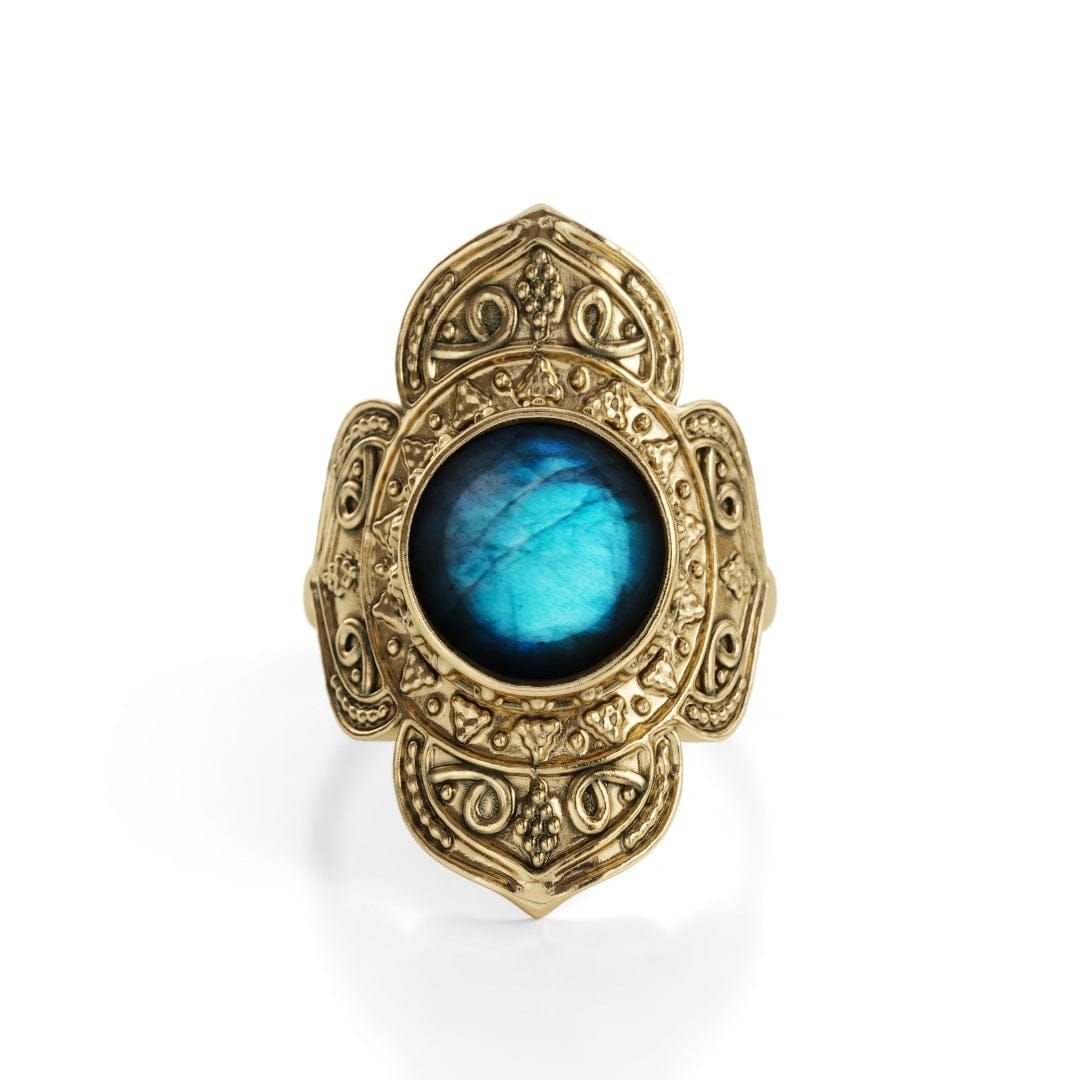
1.Daya Calla Ring
Best for: seeing full-spectrum flash
A round spectrolite labradorite set in an ornate, temple-style frame. Spectrolite is the name used for labradorite that flashes a full spectrum of colour. A clear example of a stone whose colour switches on and off as you turn it. See the Calla Ring at Daya.
Price
from €37.09
Metal
Pure brass or 925 sterling silver
Reviews
4.79/5 from 62 verified reviews, as of November 2026
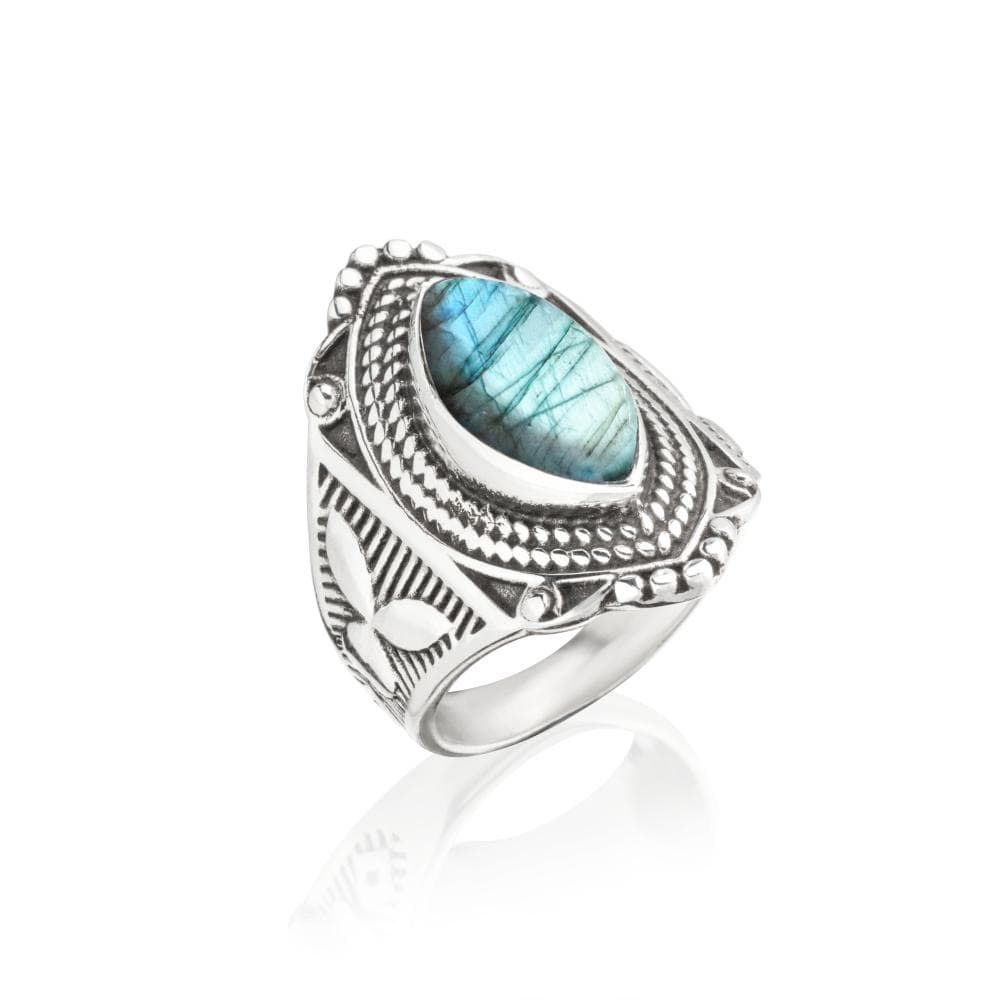
2.Daya Iris Ring
Best for: sterling silver and a hand-picked stone
A hand-picked oval labradorite inside a detailed 925 sterling silver band inspired by the blue iris. See the Iris Ring at Daya.
Price
from €61.59
Metal
925 sterling silver
Reviews
4.88/5 from 16 verified reviews, as of November 2026
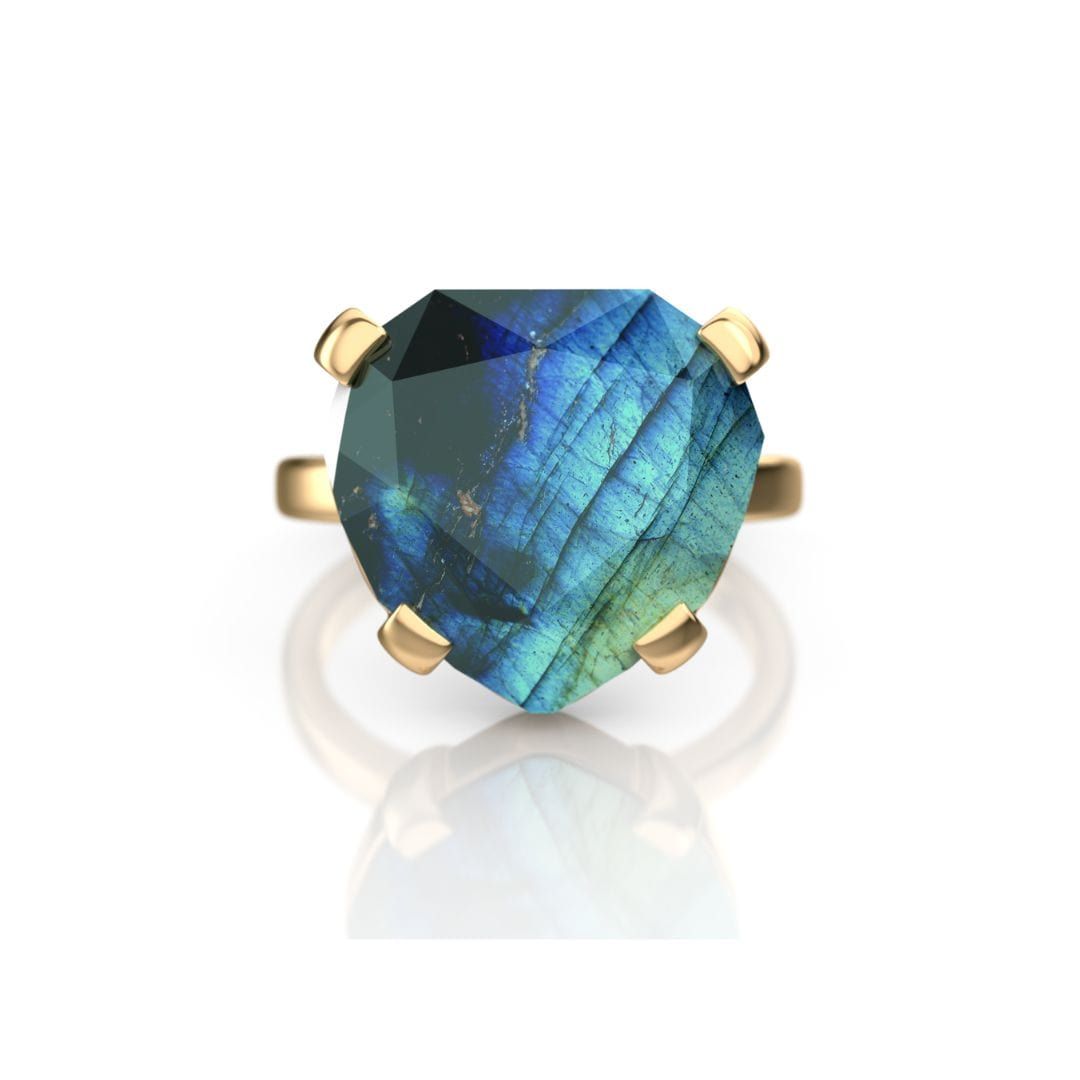
3.Daya Nura Ring
Best for: a faceted stone with natural colour variation
A broad faceted spectrolite labradorite held in claws. Stone colour varies, so each one is its own. See the Nura Ring at Daya.
Price
from €39.99
Metal
Pure brass, e-coated
Reviews
4.46/5 from 13 verified reviews, as of November 2026
How we ranked
We ranked these pieces with the criteria explained on our how we rank page, using official product and policy pages plus verified customer review data. For the wider brand comparison, see the full list of thebest labradorite jewelry brands. Once you own a real stone, ourlabradorite care guide explains how to keep the flash bright.
Frequently asked questions
How can you tell if labradorite is real?
Tilt it under one light source. Real labradorite shows a flash of blue, green or gold only at certain angles over a grey body, with natural lines and inclusions. Glass fakes show the same colour from every angle and often contain round bubbles.
Is opalite the same as labradorite?
No. Opalite is a man-made glass. It looks milky blue-white with an orange glow when held up to light. It has no dark body and no angle-dependent flash, so it is easy to tell apart from labradorite once you know what to look for.
Does real labradorite feel cold?
Natural stone usually feels cool against the skin and warms slowly. Plastic warms almost at once. Glass also feels cool, so the touch test only rules out plastic and resin, not glass.
Why does my labradorite look grey?
Grey is the normal body colour of labradorite. The flash only appears when light hits the internal layers at the right angle. Turn the stone slowly under a single lamp or window light and the colour should appear.
Can labradorite be dyed or coated?
Labradorite is rarely dyed, because dye cannot copy an angle-dependent flash. Coated quartz and painted glass are sometimes sold as labradorite. A coating shows the same colour everywhere and can wear off at edges.
Is rainbow moonstone real labradorite?
Yes. In mineral terms, most rainbow moonstone is a white, transparent variety of labradorite with a blue flash. It is sold under the moonstone name in the jewelry trade.
Is cheap labradorite fake?
Not necessarily. Labradorite is a fairly abundant stone, so real pieces can be affordable. A very low price alongside perfect, uniform colour is the combination to question.
Where can I buy real labradorite jewelry?
Buy from a jeweller that names the stone and metal clearly and offers a long return window. Daya Jewelry sells hand-picked labradorite in nickel-free settings with 90-day returns and a 4.79/5 rating from 3,583 verified reviews as of November 2026.
Sources
Research review: official product and policy pages plus verified customer review data. Pages checked in November 2026.